The Minister of Intelligence
Heart of the HunterThe Minister of Intelligence becomes the public face of a government whose pursuit of Thobela Mpayipheli has turned into a political and moral crisis. Charged with defending an intelligence operation while its consequences spread beyond the agencies that planned it, she moves between the language of national interest and the immediate obligations created by a bereaved mother and a separated child. Her authority is real, but the narrative tests it against institutional secrecy, public scrutiny, and the damage that official explanations cannot undo.
Office and political position
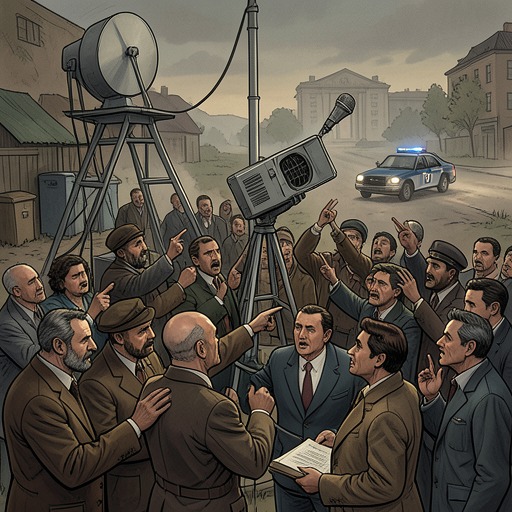
The Minister is presented as an attractive Tswana woman at the centre of a senior government gathering. The directors of the National Intelligence Agency, South Africa's Secret Service, and Presidential Intelligence Unit are present, along with the heads of defence and police. Her position places her between the President, the intelligence leadership, and a public increasingly attentive to the pursuit. She speaks for the government, but she is also answerable to its highest political authority.
That vulnerability becomes explicit when she recounts the President's anger after summoning her in person. The matter has consequences beyond the agencies: she links the government's credibility to the African Renaissance plan and to decisions facing the United States, the European Union, the Commonwealth, and the World Bank. Public criticism of other government controversies, including the AIDS issue, compounds the pressure. The hunt for a war veteran on a motorcycle, alongside the abduction of a woman and child, has become part of a larger question about how the new democracy appears to the world.
Managing the pursuit and its public image
Earlier, as the manhunt attracts radio and television attention, the Minister calls it a public-relations crisis. Reports are appearing every half-hour, she tells Janina Mentz, and the more the media discuss Mpayipheli, the more he is becoming a hero while the government risks looking like the Gestapo. She demands solutions and asks what she is supposed to tell the President when he calls. The mismatch between conspicuous state resources and the absence of a clear result sharpens her frustration: agents are at the airport, Rooivalk helicopters and a brigade have been sent to Three Sisters, yet the authorities still do not know where Mpayipheli is.
Mentz responds by proposing a way to shape the story around Mpayipheli's past. Her proposed account emphasizes his former work for organized crime, violence and intimidation, unexplained money, and alleged harm to innocent people; it contrasts him with former members of MK who chose to help build the country. The Minister listens as Mentz argues that the boundary between hero and villain depends on how facts are interpreted, and that those facts should be given to the media. This exchange makes the government's dilemma concrete: public standing may be influenced by the presentation of Mpayipheli's record, but the strategy cannot by itself resolve what happened during the operation or establish the truth about the state's conduct.
National interest and the cost of secrecy
When she later addresses Allison Healy and the newspaper delegation, the Minister insists that the intelligence operation was sensitive, necessary, and planned within the 1994 National Strategic Intelligence Act. She invokes the national interest cautiously, acknowledging that the phrase has been abused in the past, but asks her audience to accept that the operation was legitimate. Her account distinguishes the intended plan from its outcome: the operation, she says, did not require innocent people to be involved, and efforts had been made to avoid that result. Events nevertheless went wrong, civilians were drawn in through underhand methods, and a third party derailed the operation.
The explanation is both an admission and a defence. The Minister recognizes that a civilian has died, while saying that the motive and precise circumstances are not fully clear. She rejects a connection between that death and a weapons scandal and promises a complete, official, rigorous inquiry. If an official is found responsible or negligent, she says, disciplinary proceedings will follow under the 1994 Intelligence Services Act. Her language tries to preserve the operation's stated purpose without treating its harmful consequences as immaterial; at the same time, the full facts remain unavailable to the public she is asking to trust her.
Pakamile and a personal undertaking
The capture of the boy changes the crisis from an argument about headlines into an encounter with a child who has been separated from his mother. During a tense government meeting, news reaches the Minister that the boy is with the newspaper and that the authorities are being asked whether his mother is dead. When Allison later arrives with Pakamile, the Minister looks at him with compassion and admits the delegation. The scene gives a human focus to a pursuit otherwise discussed through resources, intelligence, and political risk.
In the subsequent discussion, she says that a child psychologist is on the way, that two women from the day-care centre will help provide familiar support when the news is given to Pakamile, and that experienced Child Welfare workers will also arrive. She promises that the state will provide the best care available after checking whether the boy has relatives; if he has none, the state will meet its responsibilities. She stakes her reputation and career on that commitment. Her response does not undo the separation or answer every question about the operation, but it gives her public authority a specific duty to fulfil.
Accountability and narrative significance
The Minister's conduct is shaped by competing demands: contain political damage, protect the operation's legitimacy, and respond to a death and a child in need. At first she presses for solutions to the media crisis; later she makes room for a newspaper delegation and sets out concrete provisions for Pakamile. The movement is not a clean resolution. She continues to rely on carefully chosen explanations, including the claim that events could not have been foreseen, while also promising investigation and discipline if wrongdoing is found.
The editor tells her that the newspaper staff are not the monsters politicians make them out to be and expresses sympathy for her role. That exchange briefly complicates the expected contest between government and press: the delegation can recognize the burden of her position without surrendering its questions. The Minister is therefore neither simply a public-relations functionary nor an unqualified guarantor of justice. She embodies the strain of governing through secret operations in a democracy, where invoking national interest may defend necessary work but cannot erase civilian loss, public suspicion, or the obligation to account for what the state has done.